
Tokenized Assets: Bringing the Full Financial Product Onchain
/ 3 min read
The token is one ingredient.
When a fund, a bond, or a credit product is tokenized, one thing moves onchain: a record of who owns it. The units can be held, transferred, and settled automatically.
Everything else stays behind.
What the fund actually holds sits with a custodian. Its value is calculated by a fund administrator. Maturity dates, interest rates, yield: all of it stays in the systems that produced it, updated on their schedules, in their formats.
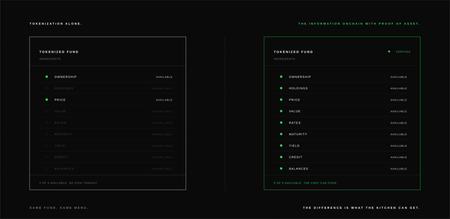
So a lending platform can see that a wallet holds 40,000 units of a tokenized fund. What it cannot see is what sits inside the fund or when any of it matures. It has the token, but not the information needed to understand the product.
That’s the gap. The token is one ingredient. Serving the full dish means bringing the rest of the information onchain too.
This is what an oracle is for and exactly what Chronicle Proof of Asset does.
Most people know oracles as price feeds, because prices came first. For tokenized financial products, price is just one part of the job. Holdings, NAV, yield, maturity, credit information, and other product-specific data needs to move onchain too.
Chronicle has been powering onchain markets since 2017 when it began as the first oracle on Ethereum, and today powers over $13.1 billion in value. For tokenized assets, Chronicle developed Proof of Asset to enable full data composition insights beyond just the price. Rather than simply confirming that a token is backed, Proof of Asset surfaces exactly what backs it, at the holdings level, with cryptographic proof.
Why a price is not enough.
A price tells you what the market last traded at. It does not tell you what the instrument holds, whether that has changed, or whether the value is supported by the underlying assets.
For a lending platform, even a stable price or NAV does not necessarily mean the collateral’s risk is unchanged. A fund can report the same NAV while exposure becomes more concentrated or the credit quality of its holdings deteriorates. Seeing the underlying data lets a platform distinguish a stable valuation from a stable risk profile.
And each new piece of information an onchain platform or risk curator can read unlocks something specific:
With price alone, a platform can value the token at a point in time. Add the fund’s NAV per share, and automated redemptions become possible. Add holdings, and the platform can see what sits behind that NAV and enforce limits on concentration. Add maturity, yield, and credit information, and lending terms can respond to changes in the underlying portfolio rather than the headline value alone.
Different products need different ingredients.
There is no universal data feed, because there is no universal product.
A money market fund is understood through its holdings, its value per share, and its yield. A private credit position is understood through its payment status, the collateral behind it, and the borrower's creditworthiness. A bond is understood through price, maturity, and coupon. A stablecoin is understood through the assets behind it and the terms for redeeming it.
The data requirements often overlap, but the exact mix differs by product. This is why Proof of Asset defines a data model for each product rather than applying one generic data feed to everything.
How the information actually travels onchain.
The process can be understood in four steps:
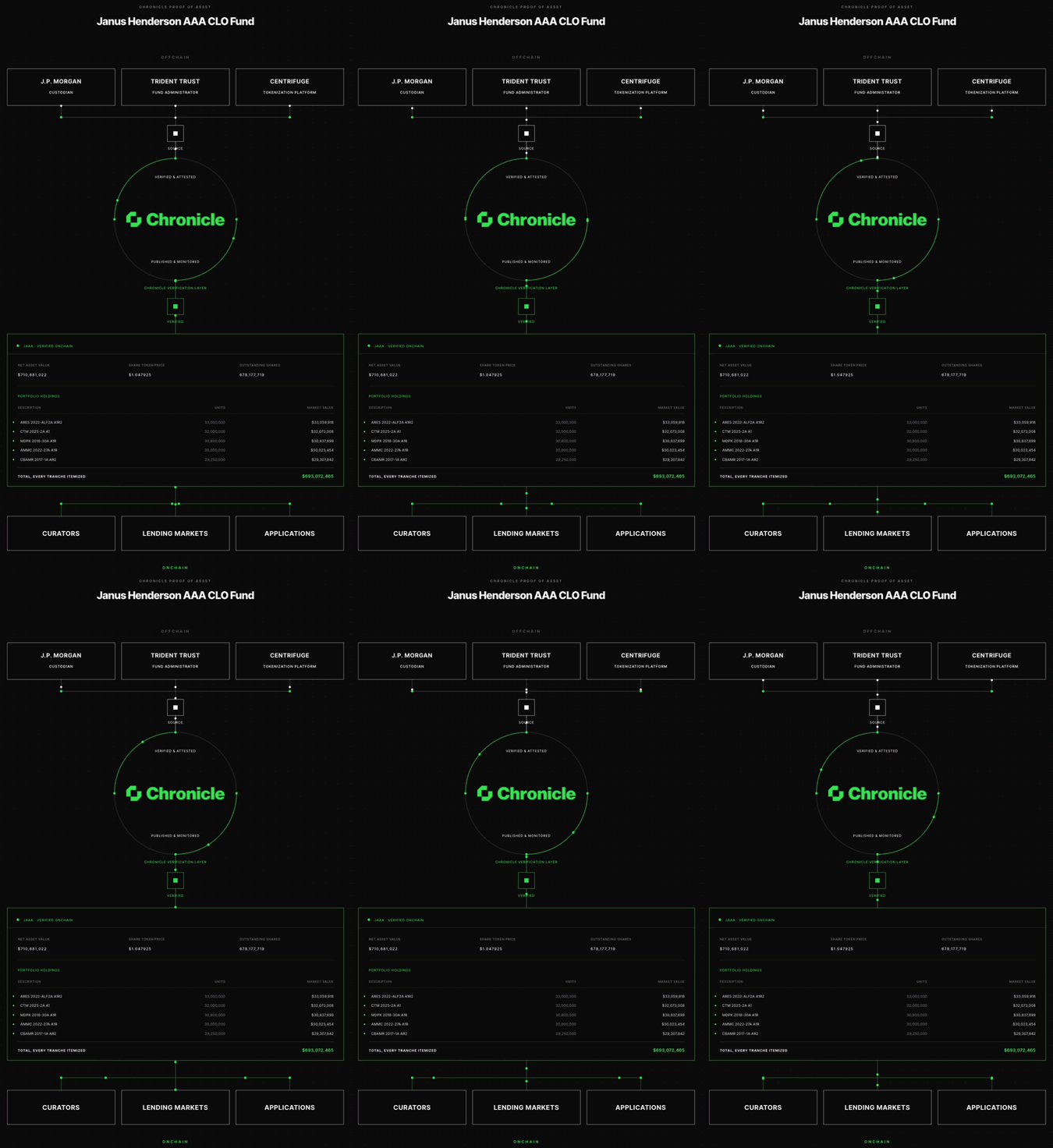
1. Offchain Asset Data
Chronicle's network sources data directly from custodians, fund administrators, and service providers. This can include portfolio holdings, NAV, reference pricing, and other product-specific data.
2. Chronicle Agent
Next, that information is structred into a defined data model.
The agent calculates the required outputs, checks the submission for completeness and freshness, and applies the methodology for the product. It then signs the data cryptographically and stores the signed record in a tamper-evident format using content-addressed storage. Any post-publication alteration to the record is immediately detectable.
3. Chronicle Validator Network
A validator network independently retrieves the Agent's record, verifies the source data and calculated outputs, and compares results. Once they agree, the validators collectively sign the verified result, creating the cryptographic proof that accompanies the data onchain.
4. Onchain Data
Once verified, the result is submitted onchain through Chronicle network's oracle infrastructure, where applications can read and use the data directly.
Depending on the product, it can be updated on a schedule, when a value moves past a threshold, or both. This is the point at which tokenized assets become much more usable: platforms can read the data directly, monitor changes, and respond automatically.
The first step happens offchain. The middle steps are where Chronicle turns financial data into verifiable data. The last step is where that verified data becomes useful onchain.
Now the data is onchain. What happens next?
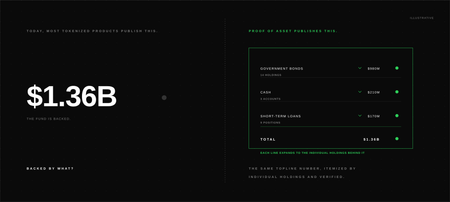
Many tokenized products still publish only a top-line figure onchain showing that the asset is backed. A single number cannot express what the product holds, how concentrated those holdings are, how liquid they are, or when they mature. It confirms a claim about the product without letting anyone verify what's actually inside it.
Proof of Asset brings that deeper layer of information onchain. Holdings, valuations, and timestamps can be published with cryptographic verification, giving platforms access to structured, checkable information about the underlying asset.
Once that depth of data is available onchain, platforms can do things that a single backing figure does not allow.
Issuers, asset managers, tokenization platforms, stablecoin builders, lending platforms, risk curators, and allocators can evaluate collateral directly on the underlying data. Rather than pricing a tokenized fund manually from a monthly report, they can continuously assess the assets backing its collateral and adjust collateral terms, such as loan-to-value ratios and liquidation thresholds, as the underlying data changes.
Vaults and risk curators can automate more of their review process. Concentration limits, asset-coverage checks, and maturity thresholds can run against regularly updated data and respond when the composition of a fund or product changes.
Integrations can become less dependent on bilateral trust. Platforms can evaluate the verified data programmatically and build protective rules around it, including circuit breakers that respond automatically when predefined collateral or reserve conditions are breached.
The data is built for an agentic economy. Software agents can read, evaluate, and act on a tokenized product using structured onchain data, rather than waiting for a person to interpret a PDF or manually delivered report.
For issuers, these capabilities expand where a tokenized product can be used. A product that lending markets can evaluate, risk curators can monitor, applications can integrate, and automated systems can interpret can participate more deeply across the onchain economy.
The full dish.
Tokenization proved that financial products can live onchain. On its own, it produces tokens that can move but cannot be fully evaluated or utilized.
The information completes the product: what it holds, what the underlying holdings are worth, how those holdings change over time, and proof for all three. That is what Chronicle Proof of Asset puts onchain.
Tokenization moves the asset. Chronicle moves the information.That's what Proof of Asset changes: a single price stops being the whole story, replaced by a full picture that's carried forward as the fund itself changes.
*Disclaimer: Chronicle provides a data and verification technology platform. Chronicle Proof of Asset and related services are strictly limited to the provision of data and cryptographic proofs. Chronicle does not issue, offer, sponsor, market, manage, administer, custody, or otherwise operate any referenced products or services, or any related underlying assets. Chronicle is not acting as, and is not licensed or authorized as, any type of financial intermediary (such as an exchange, broker/dealer, investment adviser, or custodian) in connection with any referenced products or services. Any data (including data displayed on Chronicle dashboards) is provided *