
The Tokenization Checklist for Oracles
/ 3 min read
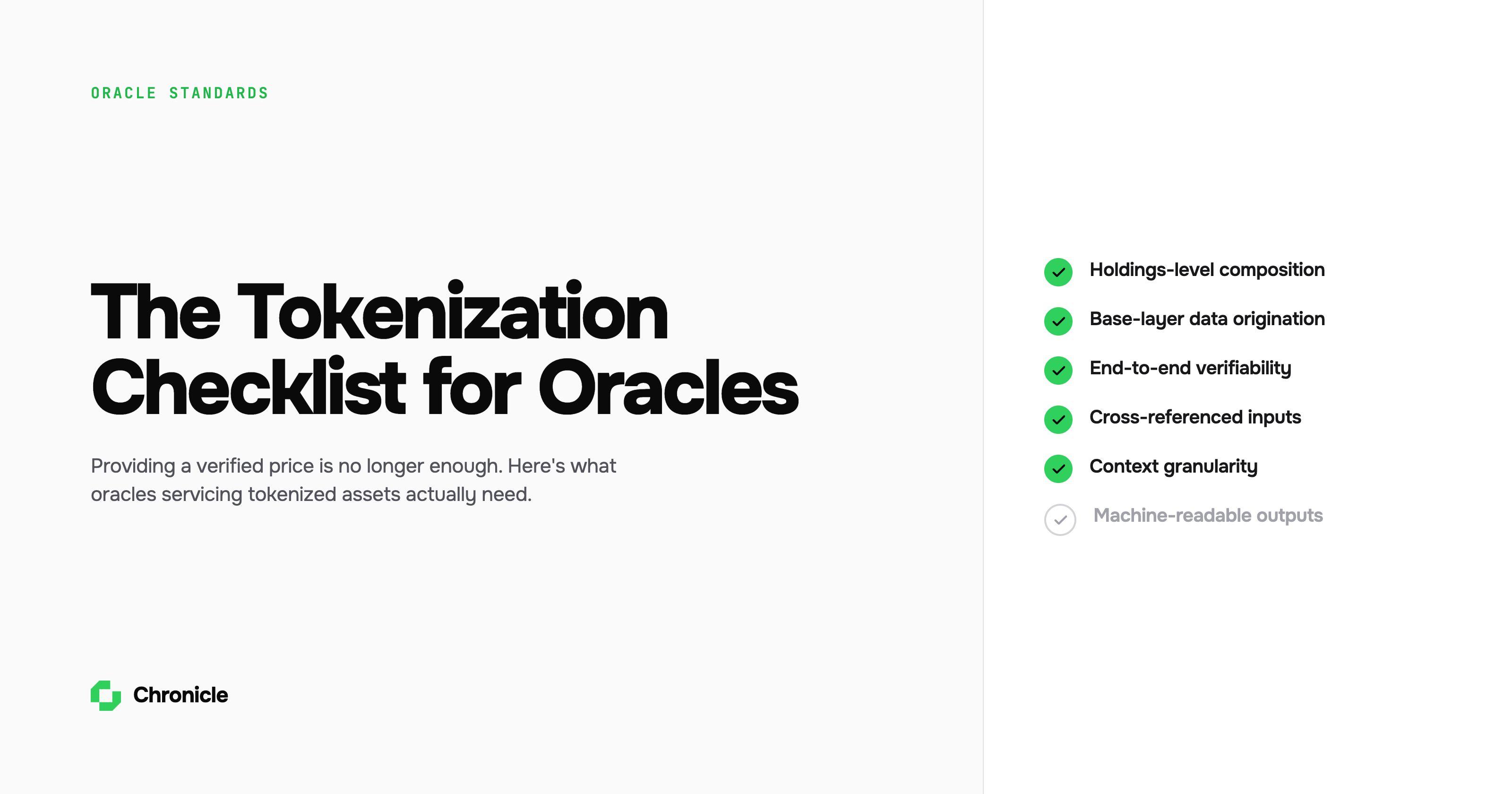
The number of real-world assets (RWAs) that come onchain climbs every quarter. But these new asset types require new standards for the infrastructure their operators rely on. Providing verified information on the price of an asset is no longer sufficient for oracle systems. That framework breaks down the moment the asset behind the token exists entirely offchain and depends on real-world factors that go beyond the onchain wrapper itself. These are the minimum requirements for oracles servicing tokenized assets, graded from critical to important to supplemental.
Critical: Must-haves for trustworthy data
1. Holdings-level composition
The single most important oracle requirement for tokenized assets is a shift from a verified number to a verified dataset. Price feeds share confirm price movements but RWAs require a dataset of what their onchain wrappers are actually backed by. Two products can carry the identical NAV and represent completely different risk profiles depending on concentration, duration, and issuer exposure underneath. This is the ground truth behind Chronicle’s Proof of Asset framework.
2. Base-layer data origination
Data has to originate at the custodian or fund administrator to minimize intermediaries before it reaches the oracle. The farther away data is from where the underlying asset is held, the more likely it is that errors or changes of data that propagate through that chain are going to affect the wrapped asset. "You want to be able to have a direct view into the securities and cash accounts... you're essentially doing reconciliation of fund accounting and rebuilding that tokenized asset from the ground up, rather than using post-calculated values by different parties in the chain." — Niklas Kunkel, co-founder of Chronicle
3. End-to-end cryptographic verifiability
Trust in the output can't depend on trust in the provider. A functional model for tokenized asset oracles has to be trustless. It can’t require users, institutions, or other protocols to trust the oracle layer. Every step, from origination to calculation to publication needs to be provable.
4. Independent cross-referencing of valuation inputs
A truthful input source can still be a single point of failure, no matter how well-sourced it is. A custodian can faithfully, verifiably, and cryptographically report a number that is itself wrong because the price they're using to mark a given holding was stale, thinly traded, or came with its own blind spots. That’s why valuation inputs need to be checked against separate sources before publication and not accepted on faith from whichever party happens to hold the data. These alternative sources can be other benchmarks or indices, a different data vendor, or an alternate custodian feed. The ideal scenario is to have a cross-referencing system in place that catches any potential manipulation or error before it ever reaches a smart contract.
Important: Necessary to make data actionable
5. Context granularity
Besides trustworthiness, having in-depth detail about an asset’s properties and rules is another important factor. This is where the oracle stops being informational and becomes structural for structured credit products or CLOs that need granular, continuously-updating data to support automated risk logic.The standard is context-aware, neutral infrastructure that another protocol can act on programmatically. All of this allows developers to build logic that responds automatically to changes in the underlying data, such as triggering circuit breakers or liquidations based on predefined parameters. This enables protocols to react before a human even notices that something has changed. Protocols like Grove, for example, rely on Chronicle for data points like concentration limits, liquidation triggers, and pause conditions. “The information that is served via the Chronicle Oracle protocol to the Grove protocol needs to be trusted. It also needs to be accurate because decisions are being made at the smart contract level based upon this information.” — Kevin Chan, co-founder of Grove Protocol in an interview with Chronicle
6. Operational and lifecycle state awareness
Price data alone is not enough to wrap the complexity of RWAs because these assets also have lifecycles and changing states. There are always operational questions that an oracle has to answer such as: Is the loan performing? Has the borrower defaulted? What is the NAV? Was there a redemption? Was it accepted or was it gated? Did the underlying collateral change? Are the cash flows current?
7. Machine-readable outputs
Verified data trapped in a PDF or a private investor portal doesn't scale. Existing operational reporting (NAV, holdings, custodian statements) needs to be made verifiable and portable onchain in order to unlock the benefits of distribution across wallets, exchanges, and DeFi apps. The data needs to exist in a format those systems can actually ingest. “So the role that Chronicle plays is how do you make this real world data available and accessible and verifiable to the onchain economy and available to these DeFi applications and these onchain investors that we're working with.” — Bhaji Illuminati, co-founder of Centrifuge in an interview with Chronicle Supplemental: Mechanisms that are good to have
8. Continuous updates
Periodic reporting in the form of quarterly statements is the default for traditional finance, and part of tokenization’s appeal is its ability to move past it. Many of these assets that are being tokenized would benefit greatly from active liquidity mechanics and instant-redemption facilities that can only exist onchain. These DeFi integrations are part of what make tokenized assets structurally superior to their offchain versions. However, they require oracle infrastructure that can provide continuous updates.
9. Defensible pricing methodology for illiquid assets
Onchain systems need defensible methodology for determining the value of assets that don't have continuous market pricing. As asset classes diversify beyond treasuries into CLOs, private credit, structured credit, and equities, this will increasingly be required of oracle systems. What’s clear is that this methodology will depend on the kind of granular datasets that are provided by frameworks like Proof of Asset. Standards are not features None of these should be understood as features. As tokenization continues to bring more complex assets onchain, these standards will become tablestakes for the tokenization of trillions in real-world assets that exist offchain. These standards serve as a checklist of the different ways to answer a question that users, institutions, and protocols are increasingly asking: What’s in the wrapper? Visit the Proof of Asset dashboard to find out.
Disclaimer
Chronicle provides a data and verification technology platform. Chronicle Proof of Asset and related services are strictly limited to the provision of data and verification signals. Chronicle does not issue, offer, sponsor, market, manage, administer, custody, or otherwise operate any referenced products or services, or any related underlying assets. Chronicle is not acting as, and is not licensed or authorized as, any type of financial intermediary (such as an exchange, broker/dealer, investment adviser, or custodian) in connection with any referenced products or services. Any data (including data displayed on Chronicle dashboards) is provided “as is”, without representations or warranties of any kind, and subject to Chronicle’s applicable terms and conditions. This post is provided for general informational purposes only and does not constitute, and should not be relied upon as, investment, legal, tax, accounting, or other professional advice, nor an offer or solicitation to buy or sell any securities, tokens, or other financial instruments, or any recommendation to engage in any transaction with any such instruments.