
The Proof of Asset Ecosystem
/ 3 min read
Every tokenized asset makes a promise that the token represents something real, held somewhere offchain. Proving that promise is true requires more than a price feed.
Proof of Asset has grown into an ecosystem spanning a wide range of asset classes, from money market funds to private credit. It’s grown across categories because each one hits the same wall in a different way.
Why the Ecosystem is Expanding
An ever-widening variety of real-world assets are flooding onchain every quarter. For the most part, they're met with price feed infrastructure that answers "what's it worth right now" and says nothing about whether the thing exists, who holds it, or whether the number can be independently reconstructed. That gap widens as assets get more complex.
Proof of Asset provides a sharp contrast as a holistic data verification layer for tokenized assets. Rather than simply confirming that something backs a token, Proof of Asset surfaces exactly what backs it, at the holdings level, with cryptographic proof.
For this reason, it generalizes across all the different asset types coming onchain. Instead of seven or eight bespoke solutions, it's one verification layer that adapts to what each asset needs to prove.
What that looks like in practice differs by asset class. Here's what the tokenized asset ecosystem looks like today.
Eight Asset Classes, One Verification Layer
Tokenized T-bills
The entry point for institutional adoption of tokenized assets has been short-duration government debt, tokenized for 24/7 settlement. Even this "simple" case still needs continuous reconciliation rather than a point-in-time attestation, since reserve confirmation has to keep pace with a NAV that updates constantly.
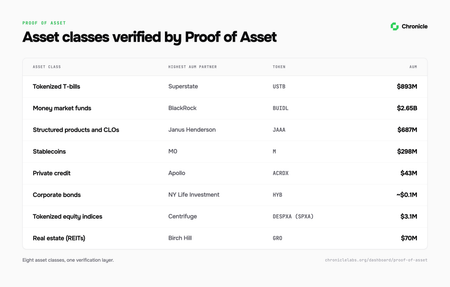
Superstate is one of the earliest RWA-native fund issuers, with $893M in a single tokenized short-duration fund secured by Proof of Asset.
Money Market Funds
Larger, multi-instrument funds spanning T-bills, repo, and cash can be wrapped for onchain use, but composition transparency becomes the harder problem. It's not enough to prove the NAV; Proof of Asset has to prove what's actually inside the fund, continuously, at institutional scale.
BlackRock's BUIDL, at $2.65B AUM, is the largest tokenized fund in the ecosystem and the clearest proof point for what institutional scale actually looks like onchain.
Structured Products and CLOs
Some products require verification to span multiple parties: issuer, custodian, and tokenization platform all at once. A notable example is the collateralized loan obligation (CLO), where pools of secured leveraged loans are tranched by seniority, with AAA as the highest level. The verification challenge here is breaking the single-source dependency, and in the case of CLOs, proving the underlying loan pool still supports the coverage tests that justify the AAA rating.
Janus Henderson is the institutional sub-advisor bringing traditional CLO underwriting standards onchain, with Centrifuge serving as the tokenization rail behind its JAAA CLO Fund, currently at $687M AUM.
Stablecoins
Stablecoins need provable backing, not trust in an issuer's dashboard. Proof of Asset reduces unbacked issuance risk by making verification of collateral data a live input to minting, rather than a retroactive disclosure.
M0 is the modular stablecoin infrastructure other builders deploy bespoke stablecoins on top of, making Chronicle's verification a shared foundation rather than a single-product integration. https://chroniclelabs.org/dashboard/proof-of-asset/m-by-m0 currently secures $298M.
Private Credit
Privately negotiated credit instruments are typically extended outside public markets and historically reported on manager timelines rather than in real time. That structure creates a specific problem where the manager is both the originator of the credit and its sole valuer. This means independent verification of the underlying book is the only way to know what's really there.
Apollo has unparalleled scale and standing in private credit generally. While its tokenized ACRDX fund is relatively small at $43M, it's a structurally significant foothold. It means a top-tier alternative asset manager choosing an independent verification layer for a historically opaque asset class.
Corporate Bonds
Rated corporate debt is now being brought onchain through segregated portfolio structures, which calls for credit risk transparency, verifying portfolio composition and credit quality on an ongoing basis rather than at a single point in time.
New York Life Investment Management's entry, via its HYB fund, is a signal that large, conservative institutional managers are choosing tokenization now.
Tokenized Equity Indices
Tokenized equity is the fastest-moving category right now, and a token tracking the S&P 500 takes that a step further by representing a basket of stocks rather than any single stock individually. Whether issuer-backed or built as a third-party wrapper, these products all need to give holders a way to verify that the token actually tracks its underlying basket.
Centrifuge's DESPXA, at $3.1M, is a small but meaningful signal of an emerging entry into the Proof of Asset paradigm.
Real Estate (REITs)
Real estate income and equity are being tokenized for onchain access, but appraisal-based NAV is infrequent and subjective by nature. Verification here means cryptographically proving the process behind a valuation update, not just the resulting number.
Birch Hill recently brought real estate income onchain in partnership with Groma and Chronicle, and its GRO token now secures $70M.
Where Proof of Asset Expands Next
Proof of Asset will continue to expand its utility into even more asset classes, including the current trend toward tokenized equities. That expansion is demand-driven. Each new class enters because an issuer needs to answer the question, "how do I verify what's backing this."
But the bottom line is that it's still early and there’s still a long way to go for RWA’s $30 trillion TAM. A wide array of asset classes remain unrepresented, including insurance-linked products, commodities beyond gold, and broader private markets.
See the full ecosystem, holdings, sources, and validators on the Proof of Asset Dashboard.
Disclaimer: Chronicle provides a data and verification technology platform. Chronicle Proof of Asset and related services are strictly limited to the provision of data and cryptographic verification signals. Chronicle does not issue, offer, sponsor, market, manage, administer, custody, or otherwise operate any referenced products or services, or any related underlying assets. Chronicle is not acting as, and is not licensed or authorized as, any type of financial intermediary (such as an exchange, broker/dealer, investment adviser, or custodian) in connection with any referenced products or services. Any data (including data displayed on Chronicle dashboards) is provided “as is”, without representations or warranties of any kind, and subject to Chronicle’s applicable terms and conditions. This post is provided for general informational purposes only and does not constitute, and should not be relied upon as, investment, legal, tax, accounting, or other professional advice, nor an offer or solicitation to buy or sell any securities, tokens, or other financial instruments, or any recommendation to engage in any transaction with any such instruments.